
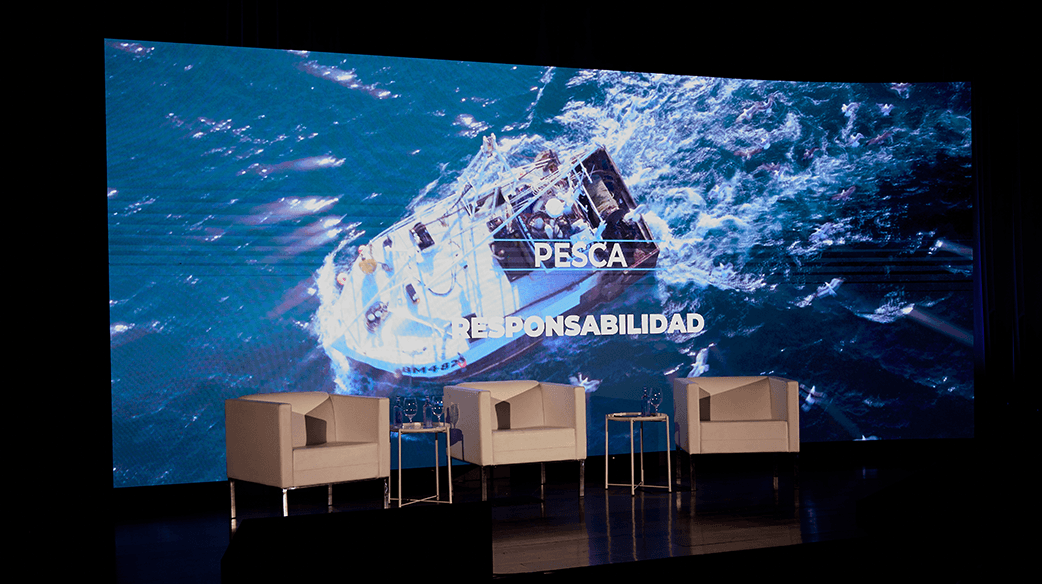
Under the theme ‘Responsibility and Impact’, the Global Sustainable Seafood Galicia Forum (GSSG) held its fourth edition in Vigo on 28 April. The opening ceremony was led by the President of the Nueva Pescanova Foundation, José María Benavent, and attended by the Sea Councillor, Marta Villaverde; the Mayor of Vigo, Abel Caballero; and the Secretary-General for Fisheries, Isabel Artime. The Government Delegate in Galicia, Pedro Blanco, was also present.
With over 350 attendees (both in person and online) from more than twenty countries, the GSSG Forum is establishing itself as a key event for global debate and knowledge exchange on the sustainability of fisheries and aquaculture, reflecting the reality of a responsible industry that is committed to the future.
During the opening ceremony, Sea Councillor Marta Villaverde highlighted Galicia’s role as an international leader in the responsible management of marine resources, at a time when sustainability is emerging as one of the world’s major challenges. Villaverde emphasized that sustainable fishing and aquaculture must go hand in hand with preserving the marine environment.
The Mayor of Vigo, Abel Caballero, stated that Vigo embodies sustainability in fisheries and marine protection. He highlighted the importance of the fourth edition of the GSSG Forum, and the international partnerships and cooperation it fosters in the pursuit of sustainable fisheries and aquaculture.
For his part, the President of the Nueva Pescanova Foundation, José María Benavent, noted that the GSSG Forum aims to foster transparent debate, considering the sector’s efficiency while never losing sight of the fact that strong performance has positive consequences for society and the planet.
The opening ceremony was also attended by the Secretary General for Fisheries, Isabel Artime, who stated that the seafood sector is moving towards a model in which responsibility guides action and impact measures results.
International experts and different perspectives
The forum began with an update on the Blue Transformation programme by the FAO expert Diana Fernández de la Reguera, who highlighted the role of rapidly developing sustainable aquaculture in feeding the world’s growing population in the coming decades. She noted that the Blue Transformation programme provides the guidelines and tools to drive sustainable growth.
In the first panel, ‘Responsible Fishing and Impact’, Rupert Howes, Executive Director of the MSC; Juan Corrales Garavilla, Senior Advisor at the Tri Marine Group; and David Carter, CEO of Austral Fisheries, demonstrated how third‑party certification schemes have helped industries improve fisheries management. In the case of tuna, this means that over 90% of catches now come from sustainable fisheries. The speakers emphasised that the industry’s success is built on robust and stable fishing rights that enable long‑term operations, as well as a strong commitment to local communities. The panel was chaired by Marcelo Hidalgo, Director of Operations at the Papua New Guinea Fisheries Industry Association.
The next round-table discussion, “Responsible Aquaculture and Its Impact”, featured Simone Maridueña, Environmental Coordinator at the Ecuadorian Municipal Chamber of Aquaculture, who explained that mangroves are an ally of aquaculture, capturing and storing large amounts of carbon dioxide. Gianluca Marino, Professor of Marine Sciences at the University of Vigo, analysed the limitations and opportunities of aquaculture and blue carbon. The session was chaired by Nuno Cosme, Chief Sustainability & CSR Officer at the Nueva Pescanova Group.
During the third panel on the topic of ‘Employment and socio-economic development’, the Mayor of Lüderitz, Brigitte Fredericks, illustrated how a strong fishing industry, supported by political commitment, was able, in the 1990s, to transform a deserted town of 2,000 inhabitants into a town of over 20,000. Gonzalo Rodríguez, Professor of Applied Economics at the University of Santiago, highlighted the importance of the fishing industry in retaining the population in the region and fostering a commitment to the future. The panel was moderated by Eduardo Míguez, Deputy Director of the Puerto de Celeiro Group.
Millions of tonnes of food are wasted throughout the value chain, right up to the point of consumption. At the fourth round table on ‘Responsible Consumption and Impact’, Paloma Sánchez, Director of Sustainability at FIAB; Ricardo Castro, Quality and Environment Manager at Vegalsa‑Eroski; and Nuria de Pedraza, Director of Communications at AECOC, discussed how to tackle food waste, an issue that significantly undermines the sector’s collective efforts.
Marine Protected Areas safeguard the health of the ocean and the future of the sector. At the fifth panel on ‘Responsible Science and Impact’, Fanny Douvere, Head of Ocean Planning and Sustainable Management at UNESCO-IOC, explained the role of these areas in protecting ecosystems, conserving biodiversity and restoring species. For his part, IEO-CSIC researcher David Díaz presented some success stories from these protected areas in the Mediterranean. The subsequent panel was moderated by CETMAR Director Rosa Chapela.
The final session featured a discussion on the impact economy led by Gerbrand Haverkamp, CEO of the World Benchmarking Alliance, who encouraged the sector, especially in times of geopolitical volatility, to take a long-term view and persevere with positive initiatives: “Keep publicly talking about your impact—on climate, nature, and people—and how these in turn are affecting your business. Showing this interdependence—and what you’re doing about it—is the most powerful way to build an impact economy, one where responsibility, accountability, and persistence to improve our impact are not just ideals, but the foundation of business success”.
The day concluded with a summary of the main conclusions by the Forum’s Co-Director, Ángel Matamoro, followed by speeches from the President of the Nueva Pescanova Foundation, José María Benavent, and the Director-General for Fisheries, Aquaculture and Technological Innovation at the Regional Government of Galicia, Isaac Rosón.